
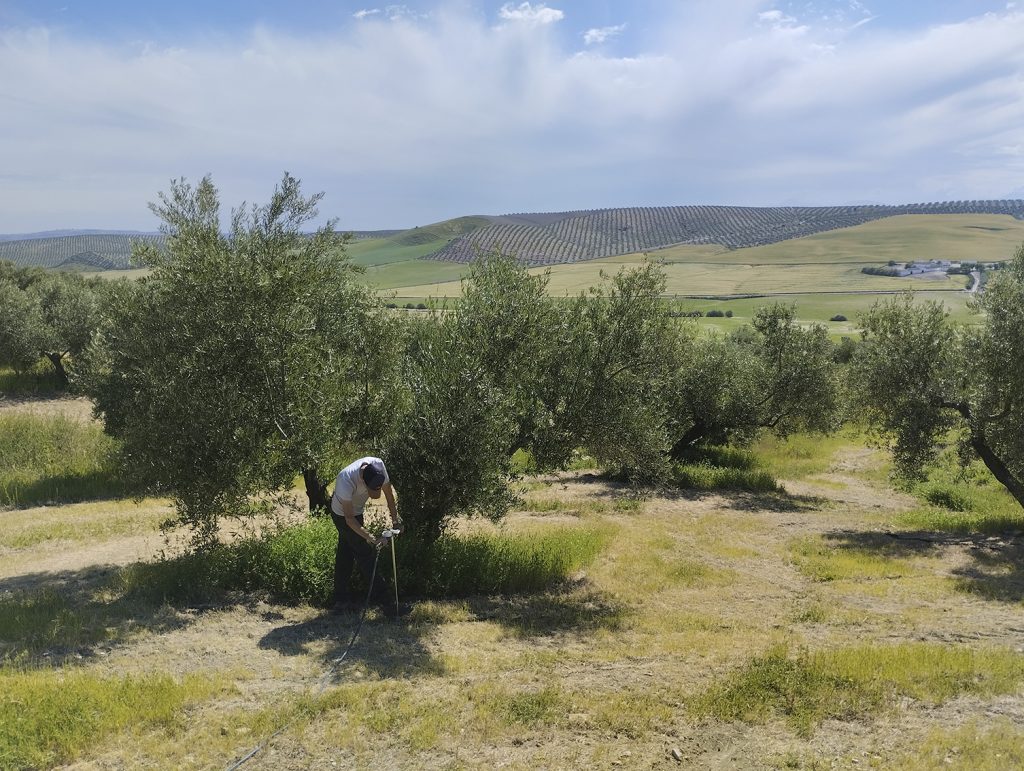
Researchers from the European Soil O-Live project have implemented pioneering techniques to try to improve the health of the soil and the yield of olive groves. Specifically, one of the latest actions has taken place on the “El Valle” estate, located between the Cordovan towns of Cañete de las Torres and Baena, one of the 52 plots of land on which the researchers of this 100% European-funded project are working.
For this purpose, an experimental design has been used that contemplates different treatments that will be periodically evaluated to study their possible impact on soil health indicators and also on the yield of the treated olive trees. One of these treatments consists of the application of biochar or high quality charcoal generated from the remains of olive tree biomass. This leading practice in Spain is carried out by CarbOliva, a company from Seville and located in Puente del Obispo, which collaborates with Soil O-Live, and which is dedicated to the valorisation of plant remains from the olive grove with the aim of making the olive sector more sustainable.
“This plant-based amendment, which is the product resulting from the thermal transformation, at relatively low temperatures, of organic waste with low oxygen supply, has a high potential for improving agricultural soils,” says Iván Sánchez, a researcher on the project. “Its structure is very porous, so it has a great capacity to retain water-soluble nutrients and water, thus improving soil conditions,” adds the researcher. In this sense, he reports that it has been shown that this practice can improve certain physico-chemical properties of the soil as well as increase carbon sequestration. “In addition, certain beneficial soil microorganisms, such as nitrogen-fixing bacteria and arbuscular mycorrhizal fungi, can be favoured by the presence of this type of material, which provides them with an ideal habitat for their development”, he adds.
For Álvaro Espuny, manager of CarbOliva, this firm has a great synergy with the Soil O-Live Project “because biochar increases the carbon content of the soil, increases water retention and generates a micropore habitat that facilitates the increase of microbiota, so essential for the olive grove”, he reports.
With the idea of studying the possible interactions that could take place between this highly stable and persistent material and beneficial microorganisms in the soil, a microbial inoculum was applied in some cases, provided by another collaborating company, on this occasion of Dutch origin, Koppert. This inoculum, which was applied to the first layers of soil with the help of an infiltrator, consists of viable spores of arbuscular mycorrhizal fungi. “This type of fungi, which establish symbiosis through their roots with at least 80% of plant species, has the capacity to provide a large number of advantages in the soil-plant system, such as improving soil structure through the production of mycelium (fungal structure similar in appearance to a root) and adherent substances such as glomalin (glycoprotein) that favours the formation of aggregates and the retention of organic matter,” says Sánchez. In addition, arbuscular mycorrhizae can increase agricultural yields thanks to their facilitating role in the acquisition of nutrients and water by plants.
For Pablo Ibort, scientific researcher at Reka BV (producer) and Koppert España SL (distributor), participating in the project gives them the opportunity to show olive growers the implementation of tools such as mycorrhizae-forming fungi for integrated crop nutrition, with a product that is marketed under the name ViciFix. “This also increases their resistance to abiotic stresses such as drought and improves soil quality in the medium to long term,” he says. In the same way, synergies can be explored with other products available on the market (such as biochar/charcoal), “which allows for a holistic management of the cultivation system”, he adds.
The present study aims to shed light on the possible effect of both treatments, together and separately, on the soil-plant system of an olive orchard with adult trees, which makes the challenge of achieving improvements at different levels even greater. However, it is hoped that the presence of such a porous material as biochar may serve to facilitate the process of interaction between the arbuscular mycorrhizae and the adult olive trees to which both treatments were applied.