
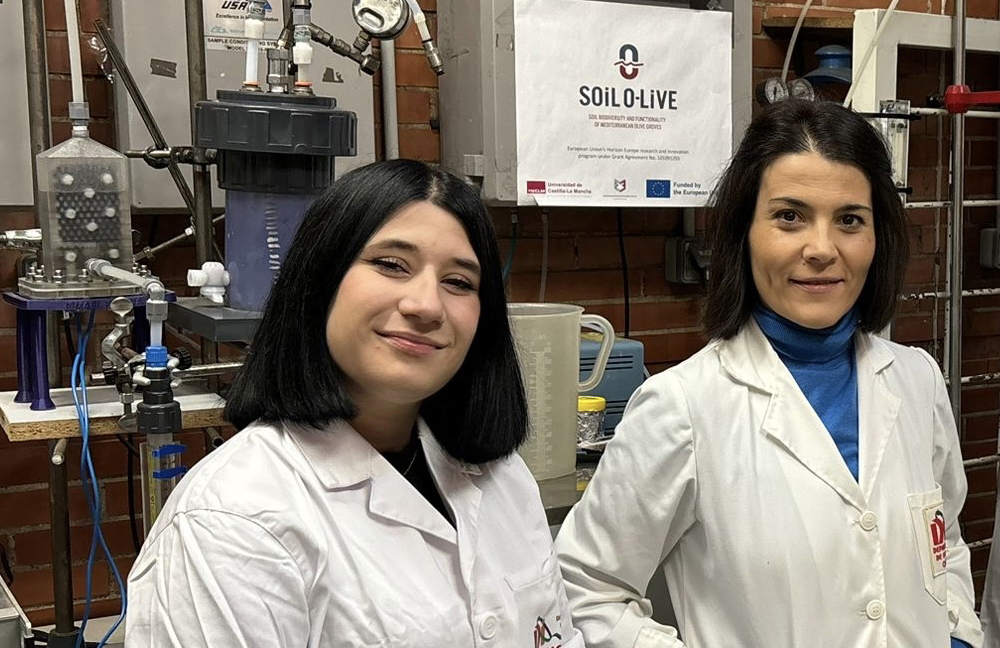
The Soil O-Live project continues to have scientific repercussions, this time in the discipline of electrochemistry. The prestigious journal ‘Electroquímica Acta’ Grant Agreement nº101091255 has echoed Soil Olive’s research on electrokinetic remediation of agricultural soils contaminated with copper developed by a group of researchers from the University of Castilla-La Mancha attached to the European project.
The article is signed by Cristina Navas Higuero, Bryan Andres Tiban Anrango, Engracia Lacasa, Manuel Andrés Rodrigo Rodrigo and Cristina Sáez Jiménez, researchers at the Department of Chemical Engineering of the Faculty of Chemical Sciences and Technologies, located at the Ciudad Real Campus of the University of Castilla-La Mancha.
The published research investigates the use of electrokinetics for the remediation of real agricultural soil contaminated with copper-based fungicides, evaluating the use of chelating agents to enhance its mobility under applied electric fields. In broad terms, the research aims to test whether it is possible to transport copper to a specific point in the soil using the chemical compounds EDTA and EDDS and subsequently remove it. This procedure has been studied extensively for copper removal from industrial and mining soils, but less so in agricultural soils where the physicochemical properties of the soil and the organic content may play an important role in the removal efficiency.
The publication highlights the challenge of copper contamination of agricultural soils as a threat to crop productivity and food security.
The main conclusion of the study is the significant potential of electrokinetic remediation to remediate agricultural soils with high metal retention, which makes it very useful for the Soil O-Live project that is currently in the restoration phase. At this stage, the aim is to further improve soil health and provide solutions to specific problems identified in the project, such as the presence of different types of contaminants in these soils and the low biodiversity they harbour.