
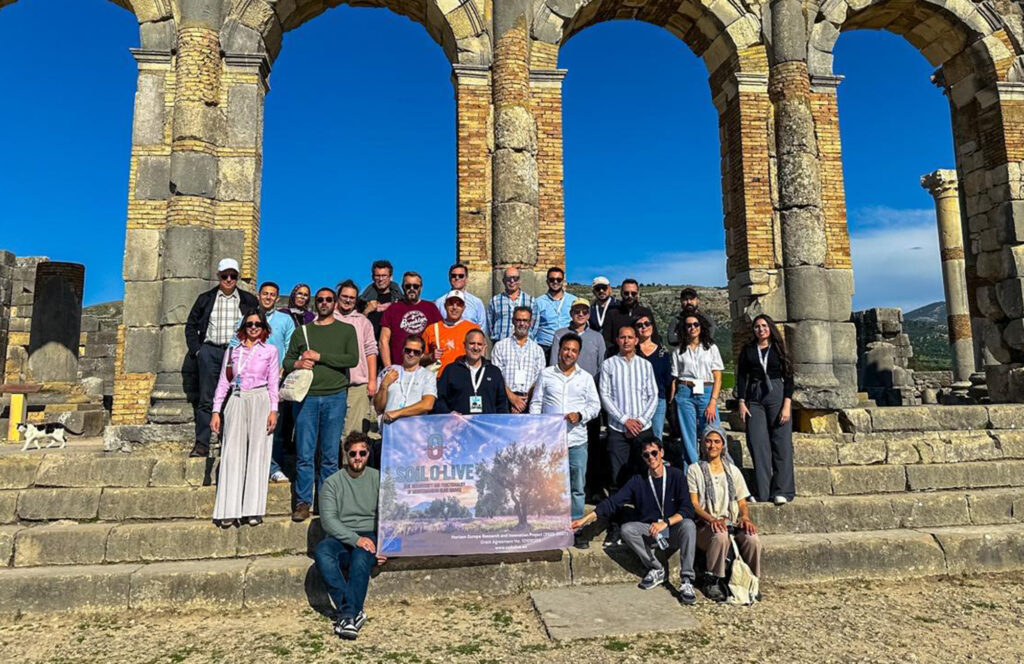
The European Soil O-Live project, coordinated by the University of Jaén, has successfully concluded its fourth annual meeting in the city of Meknès (Morocco). The meeting brought together experts from seven countries alongside representatives from the European Commission and the International Olive Council (IOC), establishing itself as the most ambitious scientific initiative to safeguard the future of Mediterranean olive groves.
The project coordinator and lecturer at the University of Jaén, Antonio Manzaneda, described the event as a “resounding success” thanks to the excellent work of the host institution, the National School of Agriculture in Meknès, and, on its behalf, Professor Aadil Bajoub, “with a scientific programme of the highest standard and an extraordinary programme of complementary activities, both agronomic and cultural”, he emphasised. He also explained that during the meeting they reviewed the various work packages, highlighting, within the olive grove soil remediation phase, the use of biochar-based organic amendments, the use of hydro-infiltrators, as well as the chemical electroremediation experiments to be carried out by the University of Castilla-La Mancha.
Regarding the communication and dissemination of the project’s results, he announced that the Soil O-Live Sustainability Protocol is now a reality and will be presented shortly in collaboration with the Spanish Standards Agency (UNE) and the European Committee for Standardisation (CEN/TC). He also confirmed that the third edition of the Soil O-Live International Competition: Soil Health and Olive Oil Quality will be launched in May 2026 in collaboration with Deoleo Global, bringing together cutting-edge science with the needs of the industry.
For his part, Aadil Bajoub, a lecturer at the National School of Agriculture in Meknès (ENA), echoed this positive assessment of the meeting, highlighting the importance of combining the scientific aspect with practical application in the field. “Meknès, as the historic capital of olive oil production in Morocco, accounting for 60% of national output, has offered the consortium a unique opportunity to discover the diversity and types of Moroccan olive-growing systems, with a vision clearly focused on the future of the sector,” he said.
Bajoub placed particular emphasis on the consensus reached by the experts, which is based on three key pillars. Firstly, the view of the soil as a living system as the cornerstone of olive grove sustainability. Secondly, progress towards concrete solutions based on applied innovation, such as hydro-infiltrators or organic soil amendments, to improve the resilience of olive-growing systems. And, thirdly, the importance of international cooperation and knowledge transfer to translate scientific knowledge into real impact for the sector.
Both agreed to emphasise that all the work carried out is aimed at a more resilient and innovative olive growing sector, one that is aligned with the climate and environmental challenges facing the Mediterranean.