
The European Soil O-Live project has announced the third edition of its International Olive Oil Competition, The Soil Health & Olive Oil Quality Awards 2026, a pioneering global event as it is the only one that jointly assesses the quality of extra virgin olive oil and the health of the soil from which it is sourced.
Following the success of the two previous editions, the competition once again highlights the close relationship between land management and product quality. The project, which benefits from Deoleo’s strategic vision, has scientifically demonstrated this connection through the analysis of natural soil respiration, the polyphenol content of the oils and their resistance to oxidation.
The main new feature of this third edition is the inclusion of the ‘ripe fruit’ category. This award has been created to recognise estates which, despite producing oils with more mature sensory profiles, maintain soils of high biological quality and produce extra virgin olive oils of an extraordinary standard.
Alongside this new category, the competition will continue to recognise the best extra virgin olive oils produced from healthy soils in the medium green fruity and intense green fruity categories, as well as awarding a special prize for the healthiest soil among all the entries.
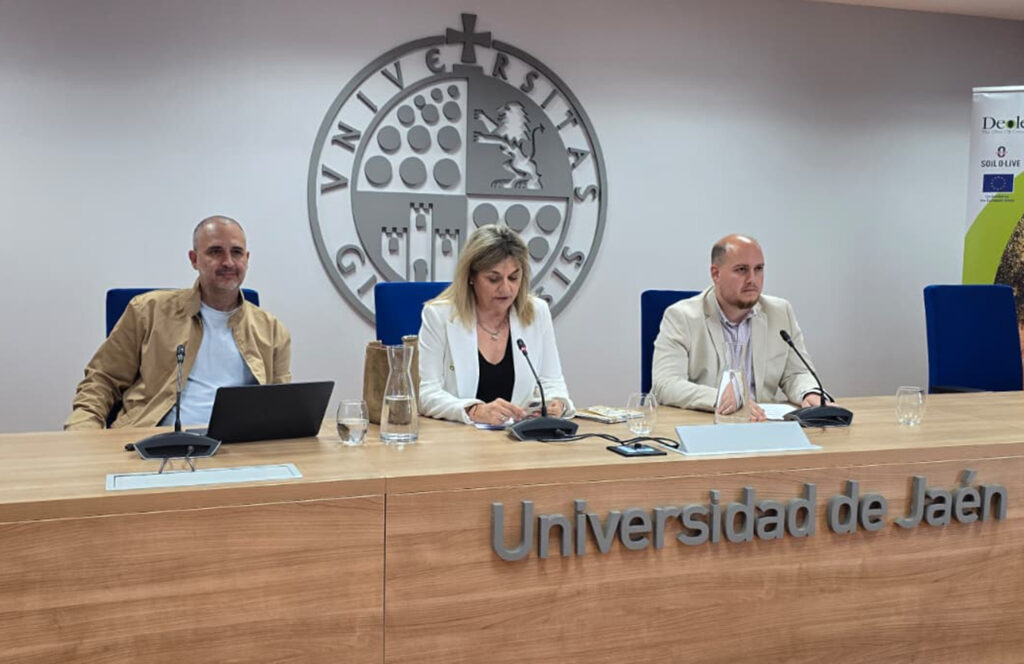
The official launch of the competition took place on Monday in Jaén, attended by Victoria López Ramón, Vice-Rector for Research and Knowledge Transfer at the University of Jaén; Bartolomé Lara, Sustainability Officer at Deoleo; and Antonio Manzaneda, coordinator of the Soil O-Live project.
During her speech, the Vice-Rector for Research and Knowledge Transfer at the UJA noted that this competition has established itself as the only one in the world that scientifically assesses the link between soil biological health and the excellence of EVOO. “In this third edition, we are taking a historic step by introducing the new category of ripe-fruit oils, recognising that the biological quality of the soil is compatible with various organoleptic profiles, always seeking the utmost purity,” she said. She also emphasised that research is the foundation for transforming the economic and environmental landscape into a sustainable evolution. “At the University of Jaén, we are convinced that the future of science is global, and we are resolutely promoting the international profile of our researchers, supporting their leadership in projects that address the challenges facing our region. We firmly believe that research is an investment in knowledge, and innovation is the application of that knowledge to generate well-being. Together, they are the essential tools for evolving towards a model of sustainable, inclusive and equitable development,” stated the Vice-Chancellor, who referred to the Soil O-Live project as “a living example of the shared responsibility of all UJA staff that makes high-level science possible”.
For his part, Antonio Manzaneda highlighted the competition’s growing success in its third year and noted that the increasing interest shown by national and international producers confirms “the direct link between soil health and the final quality of the oil”. He also explained that the internationalisation of the award will be further strengthened in this edition with significant participation from producers from Greece, Italy, Portugal and, in particular, Morocco, following the recent annual meeting of the international Soil O-Live consortium held in that country, where numerous olive growers were invited to join the initiative.
“This competition was created to demonstrate that the soil is the source of excellence. We want to highlight the importance of comprehensive care for the olive grove, starting with its foundation: the soil. Environmental sustainability should not be seen as an obligation, but as a competitive advantage capable of translating into higher-quality oils,” said Manzaneda. The project coordinator added that protecting soil life not only increases the resilience of the agricultural ecosystem, but also has a direct impact on the purity, stability and sensory uniqueness of the oil produced.
Meanwhile, Bartolomé Lara of Deoleo states: “For us, this competition is of great value, because it does not merely recognise the excellence of an extra virgin olive oil from a sensory perspective, but also incorporates a dimension that is key for us: the health of the soil from which that oil is sourced. And it is precisely this combined focus on product quality and ecosystem health that we need to continue moving forward as a sector.”
Registration deadline and technical protocol
The registration period will remain open from today until 3 June. Each participating oil mill or company must submit two samples for evaluation: firstly, 500 millilitres of the oil entered into the competition and, secondly, 50 grams of the topsoil from the olive grove of origin, together with the geographical coordinates of the plot.
This information will enable the technical team to verify the full traceability of the process via satellite and ensure the link between the condition of the soil and the oil analysed.
Samples must be sent to:
University Institute for Research into Olive Trees and Olive Oil (INUO). University of Jaén
Ecology Laboratory. Building C-6, Room 113
Paraje de las Lagunillas s/n, 23071 Jaén (Spain)
A two-stage process
The selection of the winners will begin in May with an initial scientific phase in which the Soil O-Live technical committee will assess the health of each olive grove using the soil basal respiration parameter, an indicator aligned with the future European Soil Monitoring Act. Only those samples from soils with the highest levels of biological health will proceed to the final tasting phase, scheduled for 4 June, where a panel of international experts from the International Olive Council, IFAPA, the University of Jaén and Deoleo will determine the winning oils in accordance with the IOC’s official quality standards.
A competition organised as part of the European Soil O-Live project
The competition is being held as part of the European Soil O-Live project, coordinated by the University of Jaén and fully funded by the European Union through the Horizon Europe programme.
The initiative brings together 15 academic, scientific and business institutions with the aim of promoting sustainable olive grove management practices, improving soil health and demonstrating that such improvements result in higher-quality extra virgin olive oil.