
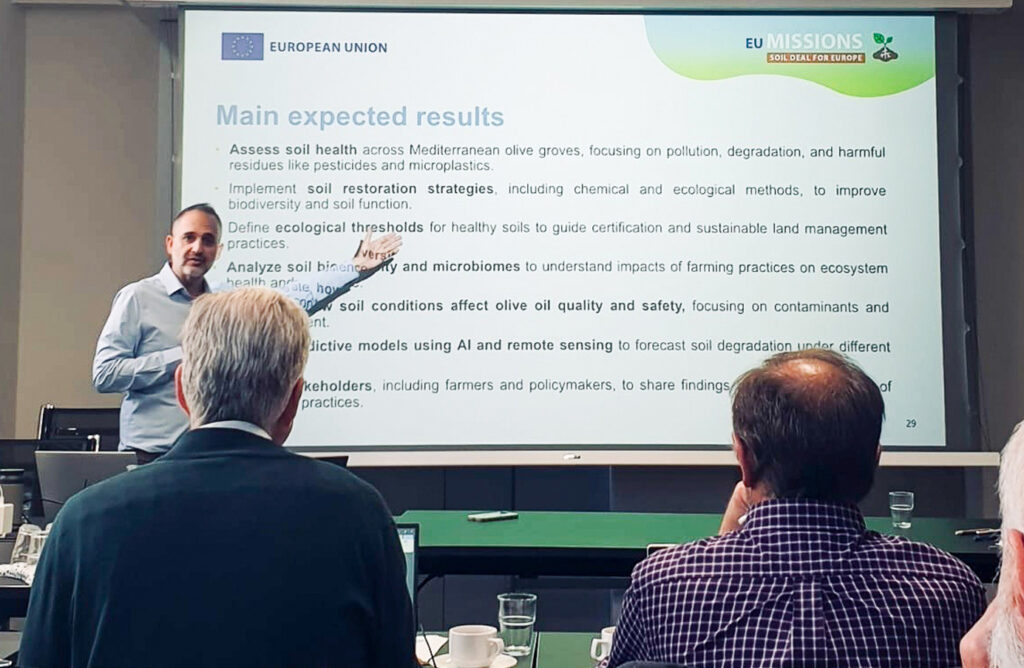
The European project Soil O-Live has had special prominence in the annual meeting of the European Technical Committee for Standardisation (CENTC/444) “Environmental characterization of solid matrices”, held in Prague. The coordinator of the project and professor of Ecology at the University of Jaén, Antonio Manzaneda, has been in charge of presenting the main advances of Soil O-Live in this important forum. Professor Manzaneda has presented these results, which have also served to analyse the aspects of methodological standardisation related to the soil health indicators that have been used in the characterisation of olive grove soils during the diagnostic stage of the project.
“We have reviewed the effectiveness of the methodologies concerning the presence of soil contaminants, microplastics, antibiotics and other relevant aspects of soil health, such as compaction, biodiversity or carbon content, which have been followed in the Soil O-Live project,” said Antonio Manzaneda. It has also been found that some methodologies followed in the project have great potential to contribute to the development of future European standards, as is the case of soil contamination by antibiotics.
In order to contribute to the development of these standards, the Spanish Association for Standardisation (UNE), which is also part of the Soil O-Live consortium, and which is responsible for the project’s standardisation activities, will nominate Professor Manzaneda as a member of the working group that will be in charge of developing European standards related to soil health measurement indicators. “It is certainly an extraordinary opportunity for the project to be able to participate in this committee and to increase its impact on something as important as the development of European standards on aspects of soil sustainability,” says Rosa Cepas, project manager for the agri-food sector at UNE.She adds: “The fact that this is the result of our research on olive soils is doubly satisfying. The members of the Committee were pleasantly surprised with the quality of the work carried out and with the potential that Soil O-Live has for the development of new standards in the field”.
Rosa Cepas pointed out that the interaction between Soil O-Live and the European Committee for Standardisation CEN/TC 444 occurs at a key moment in the future implementation of the Soil Surveillance Law, since the Committee is expected to develop standards that include methodologies for monitoring the future Law, “from Soil O-Live we hope to collaborate by contributing the knowledge and experiences gained in the project”, said Cepas.