
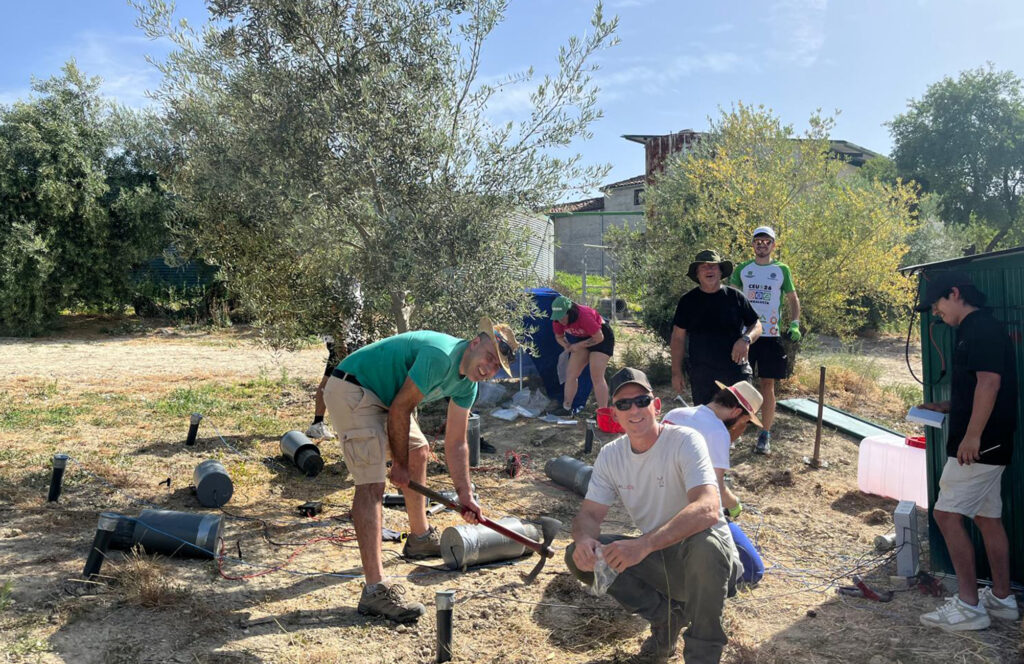
The European Soil O-Live project has taken a further step towards its goal of regenerating olive grove soils by launching two field trials using electrochemical techniques. The first trial, which is already fully operational, is testing the use of electrokinetic transport to mobilise and recover copper retained in the soil as a result of the use of traditional fungicides. Meanwhile, the second trial, due to start in a few weeks’ time, will seek to test the use of ozone generated on-site to degrade organic pesticides.
Both research projects, which have already demonstrated their effectiveness in the laboratory, are now being transferred to an experimental farm belonging to the Soil O-Live project, located in Santisteban del Puerto (Jaén), where photovoltaic energy is used to power the system.
Professor Cristina Sáez Jiménez, a professor in the Department of Chemical Engineering at the University of Castilla-La Mancha, together with her team comprising Cristina Navas Higuero, Bryan Andrés Tiban Anrango, Manuel Andrés Rodrigo and Engracia Lacasa, is leading these trials, which also involve collaboration with the University of Jaén and the Institute of Sustainable Agriculture (IAS) of the CSIC – institutions which, together with the UCLM, form part of the international Soil O-Live consortium.
The first electroremediation trial involves the application of controlled, low-intensity electric fields to remediate agricultural soil contaminated with copper-based fungicides, whilst evaluating the use of biodegradable chelating agents, such as EDDS, to increase the mobility of the heavy metal. Broadly speaking, the research aims to determine whether it is possible to transport the copper to specific points in the soil for subsequent extraction and recovery. This experiment has already begun, and the first results are expected after the summer.
With regard to the second, the technical feasibility of chemical oxidation using electrochemically generated gaseous ozone will be tested. This trial aims to degrade and directly eliminate common pesticides, such as glyphosate, in situ. The system will generate ozone on-site and on-demand using photovoltaic energy, injecting it into the soil to destroy organic pollutants without leaving secondary residues and whilst preserving the health and functionality of the soil ecosystem.
Both research projects are being carried out as part of the restoration phase of the Soil O-Live project, whose mission is to improve soil health by providing innovative solutions to critical problems identified, such as the presence of persistent pollutants and the loss of biodiversity in Andalusian olive groves.