
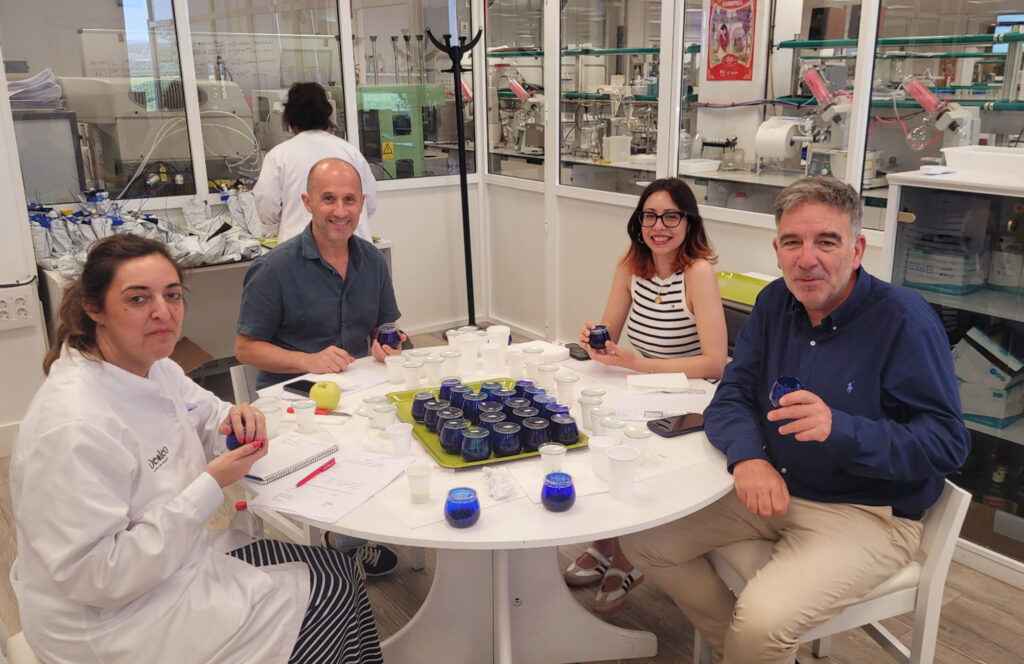
Following deliberations by its panel of international experts, the winners of the third edition of the ‘Soil O-Live’ International Olive Oil Competition: The Soil Health & Olive Oil Quality Awards 2026 have been announced. This pioneering and unique competition in the global olive oil sector has successfully established itself by assessing both the organoleptic quality of extra virgin olive oil (EVOO) and the biological health of the soil from which it is sourced.
Following the tasting and analysis of soil samples, the winners in the various categories were: ‘Light Fruity’ for KM15, produced from Picholine du Languedoc olives from Marrakech, Morocco. The experts described a light, green olive fruitiness. According to the jury’s report, “on the nose, hints of tomato plant and almond are perceptible, lending a delicate and slightly sweet nuance. These are complemented by notes of fresh grass, which reinforce its green and natural character, alongside subtle hints of nuts, which round off the overall aroma. On the palate, it has a sweet attack with gentle bitter and spicy notes, resulting in a delicate, light and balanced oil”.
In the Medium Fruity category, the award went to Olive Genesis, from the Sierra Sur region of Jaén, made from the Picual variety. The jury highlighted the green olive profile: “On the nose, there are prominent notes of green almond, aromatic herbs reminiscent of freshly mown fields, and delicate hints of wild flowers. On the palate, it is balanced and harmonious, offering a complex sensation in which bitterness and pungency are perfectly balanced”, the report states.
In the Intense Fruity category, the prize went to Almazaras de la Subbética (Carcabuey, Córdoba). The tasting panel identified an “intense green olive fruitiness”: “On the nose, there are prominent hints of cleared vegetation, notes of green almond, tomato plant and wild flowers. On the palate, the oil confirms its character: it displays a progressive pungency, which emerges gradually and elegantly, growing in intensity without becoming aggressive. The bitterness is powerful and perfectly balanced with the pungency, creating a harmonious and structured sensation. It is an oil with personality and balance, conveying both vegetal freshness and aromatic sophistication”.
The competition has also established a special category for Best Soil, which this year was awarded to Aceite Arkilakis, from the Arkilakis Estate in La Puebla de Don Fadrique, Granada. The technical committee awarded this special recognition following the recording of an outstanding soil cellular respiration rate (5.12 µg CO?-C g?¹ h?¹), which scientifically confirms the soil’s extraordinary microbial activity and biodiversity.
The competition is driven by the European Soil O-Live project, an initiative 100 per cent funded by the European Union through the Horizon Europe programme. It is scientifically coordinated by the University of Jaén (UJA). The project benefits from the strategic partnership and vision of Deoleo, a world leader in the sector.
Unlike conventional competitions, participating oil mills were required to submit both a sample of their oil (500 ml) and a physical sample of the topsoil from the source site (50 grams), georeferenced to ensure full traceability via satellite.
The selection process began with an initial scientific phase in which the technical committee assessed the biological health of each olive grove using the soil basal respiration parameter, a key indicator in line with the forthcoming European Soil Monitoring Act. Only those samples taken from land with the highest levels of biological health progressed to the final tasting phase. On this occasion, a total of 48 samples progressed to the final tasting phase.
The tasting took place at Deoleo’s headquarters on 4 June, where a panel of experts from the Spanish Association of Olive-Growing Municipalities (AEMO), IFAPA, the Oleoteca de Córdoba and Deoleo Global selected the winners in accordance with the official quality standards of the International Olive Council. The winners will receive their awards and certificates at an awards ceremony in September, the date and venue of which are yet to be confirmed.
For the project coordinator, Antonio Manzaneda, Professor of Ecology at the University of Jaén, this third edition is evidence of the competition’s consolidation, and he has highlighted the growing international interest, which confirms the direct link between soil health and the final quality of the oil. “This competition was created to demonstrate that the soil is the source of excellence. Environmental sustainability should not be seen as an obligation, but as a competitive advantage capable of translating into higher-quality olive oils,” he explains, pointing out that protecting the soil enhances the product’s stability and sensory uniqueness.
About the Soil O-Live Project
The project brings together an international consortium of 15 academic, scientific and business institutions. Its primary objective is to promote sustainable olive grove management practices, improve the health of Mediterranean soils and empirically demonstrate that such environmental improvement directly translates into higher quality and greater stability in extra virgin olive oil.