
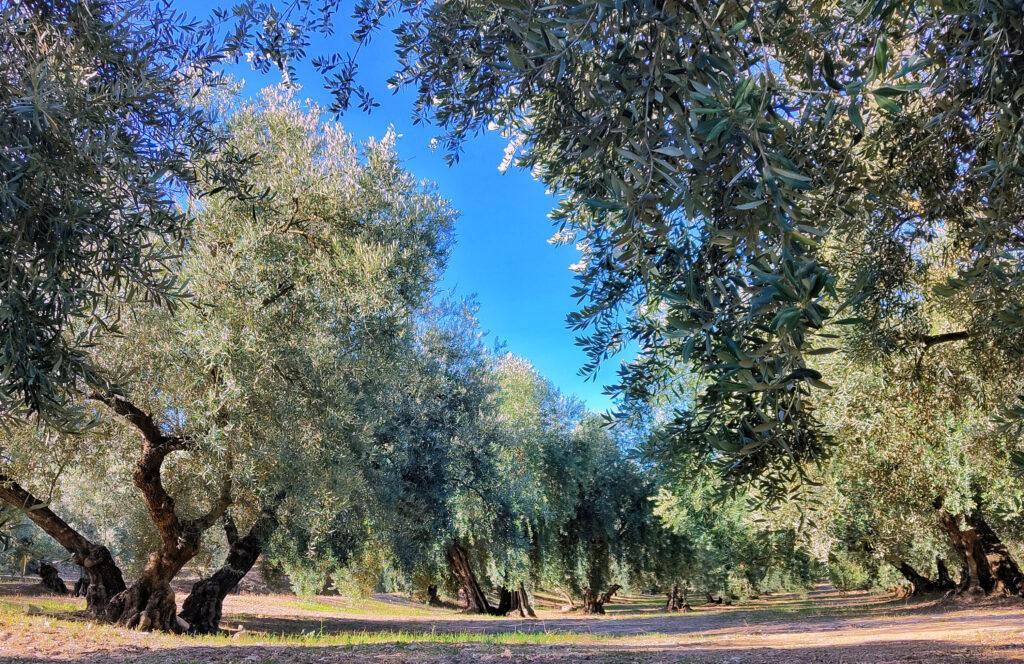
A team of researchers from the European Soil O-Live project, coordinated by the University of Jaén, has discovered a novel method for detecting glyphosate (GLY) and other highly polar pesticides in different olive grove soil management practices. This news has also been published in the prestigious journal Environmental Pollution. The article ‘Rugged LC-MS/MS method for the large-scale monitoring of glyphosate and other highly polar pesticides in soils across European Union olive orchards’ is signed by researchers from the Department of Physical and Analytical Chemistry at the UJA: Alfonso Fernández-García, David Moreno-González, Andrés J. Rascón, Ana B. Martínez-Piernas, Bienvenida Gilbert-López, Juan F. García-Reyes and Antonio J. Manzaneda from the Department of Animal Biology, Plant Biology and Ecology at the same institution.
Prior to this new method developed in the Soil O-Live project based on LC-MS/MS, determining glyphosate in soil was quite complicated due to the properties of this herbicide, its high polarity and ionic nature. In this article, the researchers demonstrate that their technique allows for accurate quantification of both GLY and related compounds such as aminomethylphosphonic acid (AMPA), which results from its degradation.
The method is based on solid-liquid extraction followed by direct LC-MS/MS using a polar anionic column and avoiding the derivatisation step. This method avoids problems such as stationary phase passivation, changes in retention time and lack thereof, analyte reproducibility, unstable sensitivity and low yield when processing a large set of samples.
To evaluate the performance of the method, it was used on around 800 olive grove soil samples from the Mediterranean basin under different soil management systems—traditional, intensive, and organic—identifying both GLY and two of its main transformation products, AMPA and N-acetyl-AMPA, in most cases. The main conclusions of these analyses are that olive grove soils under intensive and traditional production systems show substantially higher concentrations of pesticides compared to organic soils, as expected. In terms of geographical trends, Portugal exhibited the highest average concentrations in soils under traditional and intensive management. In Spain and Morocco, intensive olive groves had the highest concentration, while in Greece, it was in traditional management. Minimal trace concentrations of GLY and AMPA were also detected in organically managed soils in Portugal, Spain and Greece, due to possible contamination from applications on nearby olive trees.
This method represents a novel contribution by the Soil O-Live project, coordinated by the University of Jaén, to the discipline of environmental sciences and in relation to soil contamination by pesticides.