
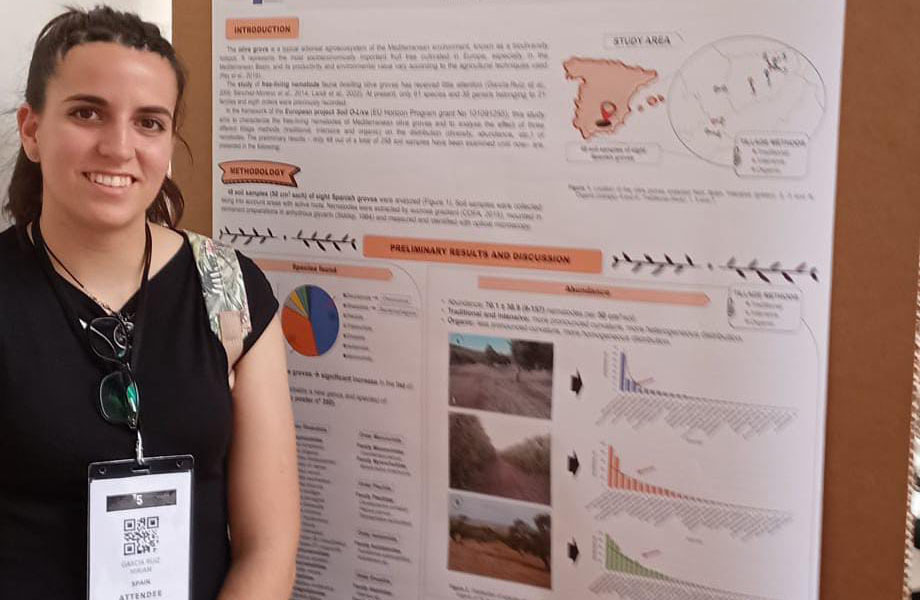
The Soil O-live project continues to make important discoveries in the field of zoology. The researchers from the University of Jaén, Miriam García-Ruiz, Joaquín Abolafia and Reyes Peña-Santiago, have described a new species of nematode that strengthens the taxonomic framework of the genus Capitellus, about which there was some controversy. This finding has been published in an article in the prestigious scientific journal Zoosystematics and Evolution (https://zse.pensoft.net/article/144719/). A few months ago, this same research group was the protagonist of the first scientific publication of the project with the discovery of another nematode of the same family.
Nematodes are very abundant and diverse invertebrate animals, which constitute an important part of the soil biomass. They perform crucial ecosystem functions, such as mineralisation of organic matter, and are involved in a large number of soil food web pathways. Analysis of nematode populations can be used as indicators of soil quality.
‘Capitellus caramborum’, the name given to the new species which is a nod to the author’s family “the Carambos”, is 0.5 to 1 mm in length and has a morphological combination that makes it different from its closest relatives. The most distinctive feature is the presence of a suction cup-shaped refractive disc in the anterior region. This new species of nematode, which has been found in an organic olive grove in Baena (Córdoba) and in an intensive olive grove in Antequera (Málaga), belongs to a group that is traditionally considered omnivorous and is associated with little altered ecosystems, where there is a well-structured food web, which could indicate ‘a priori’ the good health of these olive groves and, therefore, good soil management.
The merit of this research team from the Department of Animal Biology, Plant Biology and Ecology of the University of Jaén, which is part of the European research project Soil O-Live, lies in the fact that it is identifying the nematodes at species level, thus updating the list of biodiversity in the olive groves of the Mediterranean basin. They are also analysing the distribution of these nematode communities to assess the impact of olive grove management on soil contamination and degradation, evaluate the current situation and consider what could be done to improve quality in the future.
