The Soil O-Live project adds a new discovery to science: the relationship between the genetics of the olive tree holobiont, i.e. the association between the plant and its microbial community or microbiome, and greater or lesser tolerance to the fungus Verticillium dahliae. This is the main conclusion drawn from the article ‘Unveiling essential host genes and keystone microorganisms of the olive tree holobiont linked to Verticillium wilt tolerance’ published in the prestigious journal “Microbiome” by Antonio J. Fernández-González, Manuel Fernández-López and Jesús Mercado-Blanco, from the Department of Soil and Plant Microbiology at the CSIC’s Zaidín Experimental Station, and Alicia Serrano and Francisco Luque from the Department of Experimental Biology at the University of Jaén.
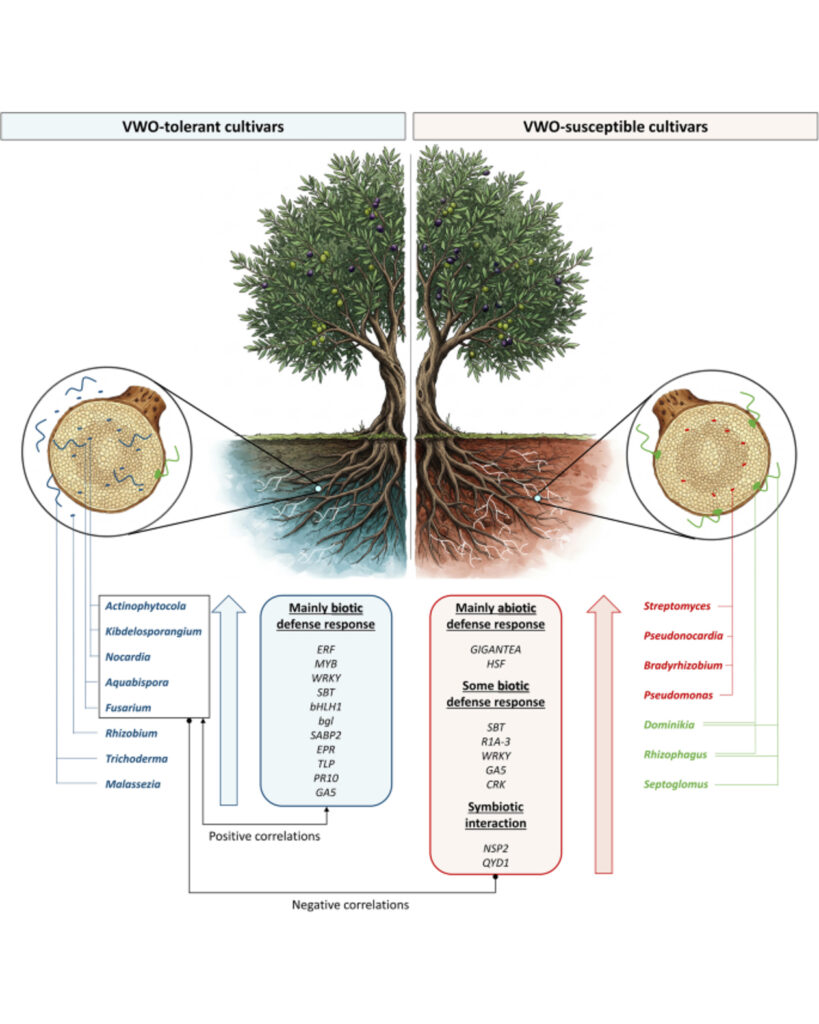
The article suggests that the microbial community residing in an olive tree influences the plant’s characteristics, such as resistance to environmental stress and disease, and that remodelling this microbiome is a promising avenue for crop disease management. This requires a deeper understanding of microbial interactions with their host plant and with each other (holobiont). To gain new insights into these relationships, the researchers set out to identify key host and microbial genes linked to Verticillium tolerance. In this vein, the team compared the microbiomes of the roots of disease-susceptible and disease-resistant olive trees, finding that certain bacterial and fungal species were more abundant in tolerant plants. In turn, a technique called co-occurrence network analysis allowed them to identify correlations between certain microorganisms and the expression of specific genes, revealing two key bacterial groups associated with tolerant olive trees and defence-related genes. These results demonstrate that combining analyses of microbiome composition and host gene expression can help unravel plant-microbiome interactions, pointing the way to new strategies that leverage microbiome engineering to improve olive tree resilience to verticillium wilt. This approach could also help answer questions about how host genes shape the microbiome and how the microbiome influences disease resistance in host plants.
In short, the research carried out within the Soil O-Live project continues to bear fruit, making significant contributions to science and, above all, to improving olive cultivation.